Several documented platform changes deserve attention in 2026. Apple published research on improving search relevance with LLM-generated training judgments. Google Play made excessive partial wake locks a technical-quality consideration for discovery from March 1, 2026. Custom product pages and broader Analytics capabilities also change the work available to developers. None of this exposes a complete ranking formula.
Reviewed September 11, 2026. This guide explains those changes and what they mean for your app. Earlier claims about screenshot indexing, fixed retention penalties and specific causes of spring ranking changes have been withdrawn because we could not substantiate them.

Confirmed changes and their practical scope
| Development | Evidence | Action |
|---|
| LLM-generated relevance judgments | Apple's February 2026 research describes an augmented production ranker and worldwide A/B test. | Describe the actual task clearly; keep relevant keywords and avoid repetition. |
| Excessive partial wake locks | Google announced possible discovery restrictions from March 1, 2026. | Check Android vitals and fix the background behavior behind the warning. |
| Keyword-linked custom product pages | Apple documents approved keyword assignments and up to 70 custom pages. | Use an appropriate approved page for a distinct user intent. |
| Expanded Analytics | Apple documents more metrics, cohorts and filters. | Measure supported source/page/cohort outcomes without inventing query attribution. |
Apple's search research: relevance, not a new keyword recipe
Apple's Scaling Search Relevance paper explains how generated textual judgments supplement behavioral labels in training. The authors report improved offline relevance and a positive worldwide App Store test. That is evidence about a search-system experiment, not a promised uplift for a developer who changes wording.
For your listing, the practical takeaway is to explain the app's function clearly. A receipt-scanning app should explain receipt scanning, expense capture and export accurately. Filling a field with loosely related AI phrases does not make an app more useful for those searches. The paper does not show that exact terms stopped mattering or that developers should replace keyword research with prompts.
Apple's search guidance still names text relevance and user behavior as inputs. Keep an evidence-based candidate list and review the generated output in metadata generation before using it in a listing.
Google Play: battery behavior can affect discovery
Google's excessive partial wake lock announcement explains that apps over the threshold may be excluded from prominent discovery surfaces, including recommendations, and may receive a listing warning. It does not say that every affected app loses a fixed number of search positions.
Open Android vitals after a release and inspect the exact affected metric, devices and app versions. Diagnose the service or SDK keeping the device awake, release the fix, and monitor the metric as the updated version reaches users. A keyword edit cannot repair a battery or stability defect.
Custom product pages: tailor the page to the query
Apple's current custom product page documentation allows up to 70 pages and keyword assignments from an approved app version. The keyword feature was described at WWDC25; it should not be presented as a newly discovered 2026 ranking hack.
For a fitness app, a strength-training page and a cycling page can show different relevant screenshots. Test whether each page explains its particular task more clearly. Keep the features accurate; custom pages do not each add a separate keyword allowance.
Prepare coherent artwork with AppDrift's screenshot generator; public template previews are available before signup. Saving and exporting require an account, while Pro collections retain their access requirement.
Screenshot indexing and retention: what remains uncertain
Screenshot text is useful to visitors and can describe the app clearly. The public Apple search guidance reviewed for this article does not establish a dedicated OCR keyword-ranking factor or an added caption keyword budget. Treat practitioner observations as hypotheses to test, not a confirmed universal rule. Our screenshot text analysis discusses that distinction.
Both platforms care about useful apps and user behavior. Neither publishes a universal Day-1 or Day-7 retention cutoff that predicts a search position for every category. A weather app and an occasional travel-planning app have different use cycles. Measure retained use for the intended job instead of chasing an unsupported ranking benchmark.
How to investigate a ranking drop
- Confirm the observation. Repeat the same query, platform and storefront. Record the time, tool, result depth and whether ads are counted.
- Check scope. Did one query move, every query for one app, or several comparable apps? Check whether the app is still available in that market.
- Review your changes. Note metadata edits, release dates, experiments, store availability and any technical-quality warning.
- Check traffic and quality. Compare downloads from the same source and follow what those users do. A lower rank with steady downloads needs a different response from an unavailable listing.
- Choose a response. Fix a confirmed defect promptly. For ordinary movement, gather repeated observations before replacing the listing. There is no universal 48-hour recovery guarantee.
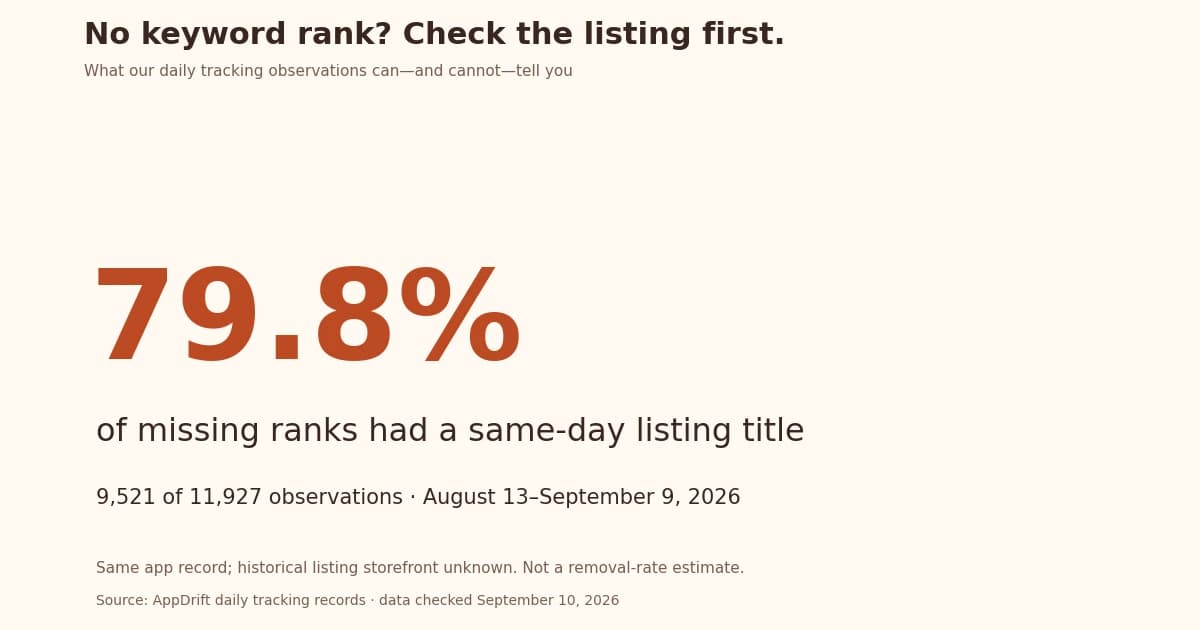
AppDrift's published rank movement study provides a dated observational baseline, not a diagnosis of Apple's internal changes. Correlation with a news story does not establish that the story caused your drop.
What to monitor next
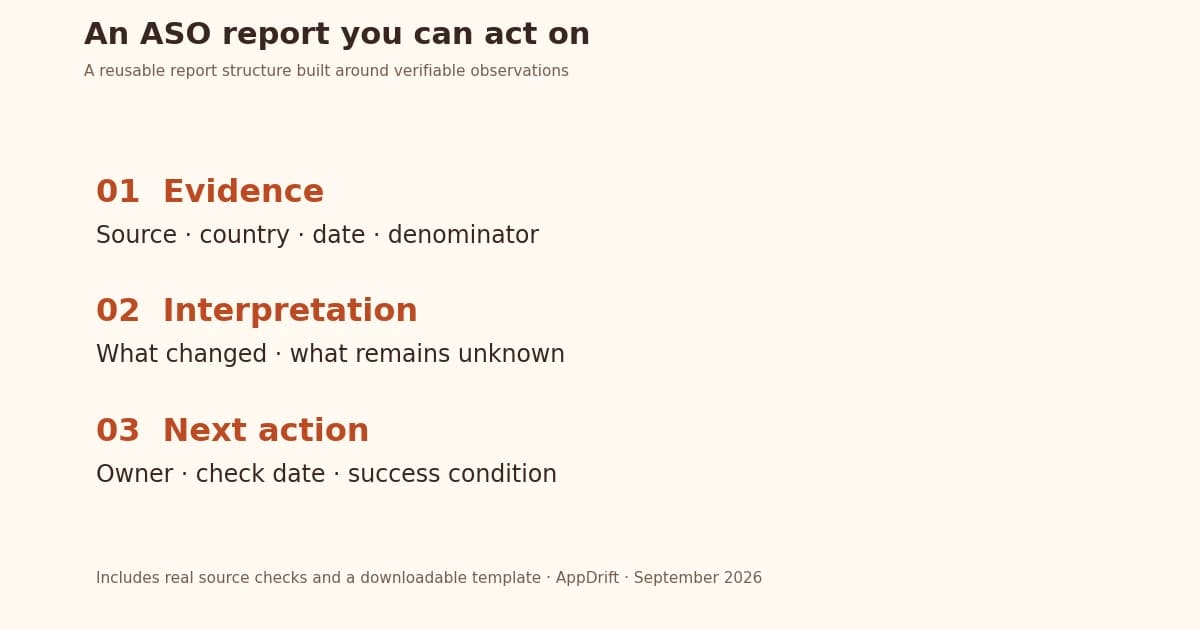
Keep a short log of the announcement, affected platform and date. Note whether it applies to your app and what you will check next. For each app, prioritize accurate metadata, useful screenshots and technical health before reacting to a speculative algorithm list. Distinguish paid placements from organic positions when reviewing the search screen. If you are choosing software for this monitoring, our comparison of the best ASO tools lists each tool's features and dated prices.
Start with one free rank check and save a baseline for the phrases that match your app. Daily tracking can reveal sustained movement; it cannot guarantee a rank improvement or explain the platform's private weights.
Frequently Asked Questions
No. Apple describes broad search inputs and publishes selected research. It does not publish weights that predict an individual app's position.
Do screenshot captions definitely add indexed keywords?
The official search documentation reviewed here does not establish that claim. Write captions for relevant users and keep experimental observations separate from platform rules.
Can battery drain affect Google Play discovery?
Yes. Google says excessive partial wake locks above its threshold may affect discovery surfaces and may lead to a listing warning. Inspect the current Android vitals report for your app.
First confirm the query, storefront, scope and timing, then check availability and release changes. Fix known issues; avoid attributing a single movement to an unverified update.