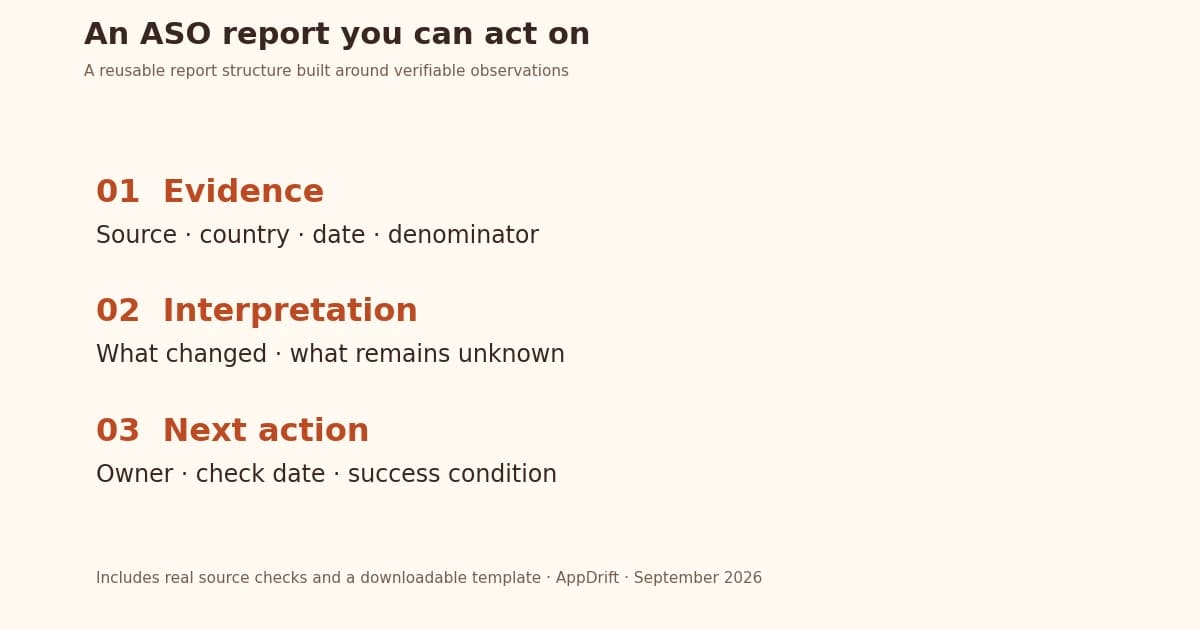
A useful ASO dashboard connects visibility, store conversion and post-install value. Start with a fixed keyword set, source-level store traffic and downloads, then add an activation event and retention appropriate to your app. Record platform, territory, date range and denominator before comparing any rate.
Rankings diagnose visibility for sampled queries. Store analytics describe acquisition within their reporting scope. Product analytics explain whether users completed a useful task. None of these alone establishes why revenue changed.

The core KPI table
| Metric | Question it answers | Main limitation |
|---|---|---|
| Observed keyword rank | Where did my app appear for this query? | Country, time, source and returned depth matter; absence is not delisting |
| Impressions or listing visitors | How much exposure or store-page traffic was reported? | Platform definitions and sources differ |
| Store conversion rate | What share of the defined audience downloaded? | Compare the same numerator and denominator |
| First-time downloads by source | Which reported acquisition sources grew? | Sources are not necessarily individual organic keywords |
| Activation rate | Did new users complete the first valuable task? | Requires a clear event and eligible-user denominator |
| Return visits by signup group | Did users return on the app's expected schedule? | Category, cohort definition and observation window matter |
| Ratings and review themes | What problems or strengths are users reporting? | Reviewers are a self-selected subset |
| Revenue or paid conversion | Did acquisition produce business value? | Attribution, trial maturity and reporting lag limit conclusions |
Visibility: track a consistent keyword set
Choose a small set spanning your brand, core tasks and a few discovery candidates. Keep store, country and collection method consistent. Add terms when the product or research justifies them; changing the basket every week makes its average difficult to interpret.
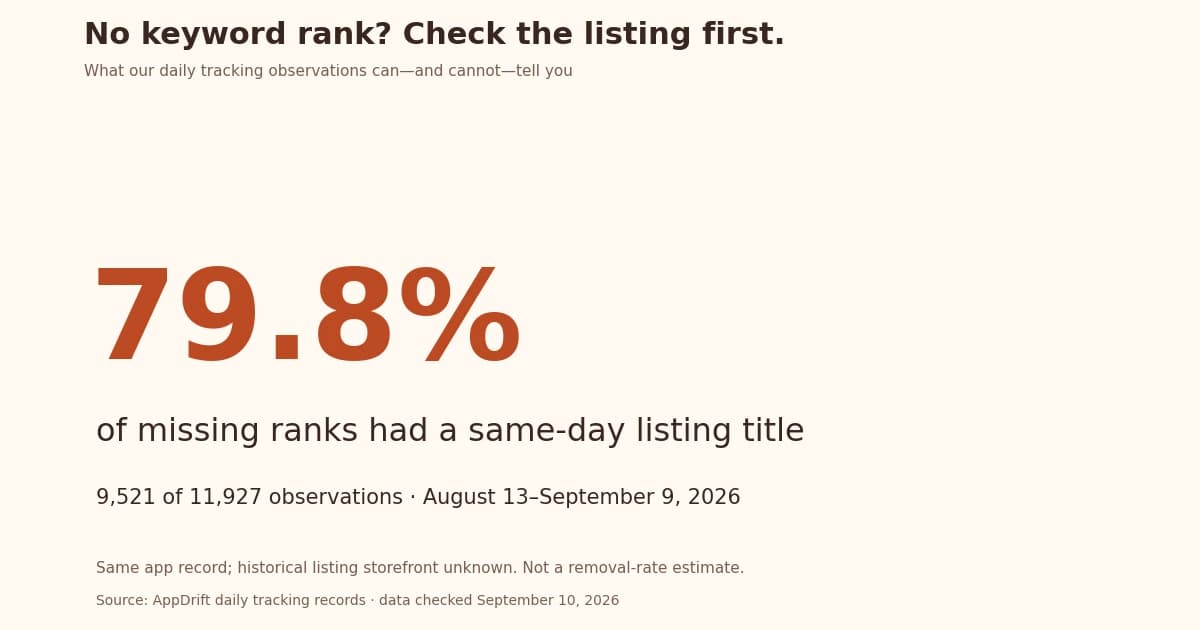
Record missing observations separately from numeric ranks. AppDrift's Android collector often returns roughly 30 results, while iOS can return a deeper sample. A missing app may be outside the returned depth, unavailable in that market or affected by collection failure. Check those possibilities before concluding it lost eligibility.
In AppDrift's dated rank-volatility study, the observed iOS mean absolute daily movement was 9.48 places across the analyzed daily checks, and movement varied by rank band. Those sample results show why a single-day movement needs context; they do not predict every app's future volatility. Read the study's sampling and missing-data notes before applying its figures to your app.
What does share of voice mean?
Third-party ASO share-of-voice scores usually estimate visibility over a chosen keyword set using positions and modeled demand or click weights. They are not your actual share of all competitors' organic impressions. Record the provider, market, basket and formula, and avoid comparing unlike scores.

Conversion: use the same denominator
Apple's headline conversion measure uses total downloads divided by unique impressions. Google Play acquisition reporting uses its own store-listing visitor and acquisition definitions. A page-view conversion rate you calculate yourself is another metric again. Label them explicitly instead of treating every percentage called CVR as interchangeable. Apple Analytics · Google acquisition reporting
Illustrative arithmetic: if 10,000 eligible listing visitors produce 2,000 acquisitions, that visitor-based rate is 20%. At the same eligible traffic, a 22% rate would produce 2,200 acquisitions: 200 more, a two-percentage-point increase or 10% relative lift. This example is not an industry benchmark or promised result.
Split conversion by source, territory, device and product page where the platform provides those dimensions. A new campaign or featuring placement can change the audience mix and the blended rate even when each segment performs similarly. A drop does not identify its cause by itself.
Acquisition: separate rank from attribution
Review first-time downloads, redownloads and acquisition sources as distinct rows. Keep paid campaign reporting separate from organic hypotheses. A paid search term that converts can inspire research, but it does not establish the revenue of the corresponding organic query.
Apple reports and connected data vary by permissions, available report categories and privacy thresholds. AppDrift's Search performance view reads Apple's App Store Discovery and Engagement and App Downloads reports: search and browse impressions, page views, downloads and conversion by country. App Store Connect analytics offers no search-term breakdown, so none of these figures is keyword-level revenue or retention. See the Apple analytics scope guide. Apple filters and dimensions
Activation and retention: follow the real usage cycle
Define one activation event a new user can reach: save a first note, complete a workout or send an invoice. Track eligible new users who complete it within a defined window. Segment by acquisition cohort when reliable attribution exists.
For retention, specify whether you mean return on an exact day, within a week or at any point after a threshold. Compare groups whose full observation period has passed. A weekly-use business app needs a different interpretation from a daily game.
Technical quality belongs beside these metrics. Google documents that excessive partial wake locks above its bad-behavior threshold can affect discovery eligibility and trigger warnings from March 2026. Follow the current console guidance rather than turning one vital into a fixed search-rank penalty. Google battery-quality update
Reviews: use themes to choose product work
Review average rating, rating count, recent distribution and recurring complaints by version or market where possible. A 30-day average is a useful internal view, not a published universal store ranking formula. Response rate measures your support process; it is not a documented direct ranking weight.
Keep prompts compliant and support accessible to all users. A complaint about crashes suggests a technical investigation. A complaint about unexpected payment suggests a mismatch between listing, onboarding and access terms. Neither alone proves why a keyword rank moved.
A weekly review that ends with one action
- Check collection failures, store availability and release dates before interpreting missing data.
- Review the fixed keyword set by territory; investigate sustained changes in relevant terms.
- Compare store traffic and conversion within the same source and market.
- Inspect activation failures and mature retention cohorts.
- Read recurring review themes and choose one action with a clear owner.
- Log the hypothesis, owner, release date and outcome metric for the next review.
For example, stable sampled ranks plus lower downloads could involve traffic demand, ads, untracked queries, availability or conversion. Inspect those separately. Do not conclude “seasonality” merely because tracked ranks stayed level.
Use experiments where they answer the question
AppDrift metadata comparisons observe successive periods; they do not randomly split store visitors or establish a causal conversion winner. Native store experiments can test supported changes to screenshots, icons and other creative assets. Choose a duration and evidence threshold based on actual traffic, and record inconclusive results instead of enforcing an automatic 14-day verdict.
Begin with the free ASO audit for a listing checklist, then use keyword tracking for a small recurring basket. Free accounts include five daily tracked keywords for one app. Store-report availability depends on the connected account and supported source.
Frequently Asked Questions
Which ASO metrics should a small team track first?
Start with a manageable keyword set, acquisition traffic and conversion by source, and one activation event. Add detail when it helps decide what to change.
What is a good app store conversion rate?
Use your own comparable source, market and device baseline, plus a relevant benchmark with the same definition. There is no single healthy rate that applies to every store, category and traffic mix.
Can I measure revenue for every organic keyword?
Do not assume so. Use only the dimensions and reports actually delivered by your store or attribution system. A rank check and a paid keyword report do not establish organic keyword revenue.
Does missing rank mean my app was delisted?
No. It can mean absence within the returned result depth, a collection issue or a market difference. Verify the direct listing and data status before treating it as an availability incident.